Physicists at Brookhaven National Laboratory (BNL) have discovered an entirely new type of quantum entanglement, the fearsome phenomenon that binds particles at any distance. In particle collider experiments, the new entanglement allowed scientists to see inside atomic nuclei in greater detail than ever before.
Pairs of particles can be so intertwined that one cannot be described without the other, no matter how far apart they are. Stranger still, changing one would result in an immediate change in its partner, even if it was on the other side of the universe. The idea, known as quantum entanglement, seems improbable to us, because we are in the realm of classical physics. Even Einstein was intrigued by it, referring to it as “spooky action at a distance”. However, decades of experiments have consistently supported it, and it forms the basis of emerging technologies such as quantum computers and networks.
Typically, observations of quantum entanglement are made between pairs of photons or electrons that are identical in nature. But now, for the first time, the BNL team has detected pairs of dissimilar particles undergoing quantum entanglement.
The discovery was made at the Relativistic Heavy Ion Collider (RHIC) at Brookhaven Lab, which probes the forms of matter present in the early universe by simultaneously boosting and annihilating gold ions. But the team found that even when the ions didn’t collide, there was much to be learned from near misses.
Detector at the Relativistic Heavy Ion Collider at Brookhaven Labs, where a new type of quantum entanglement was discovered
Brookhaven National Laboratory
The accelerated gold ions are surrounded by tiny clouds of photons, and when two ions pass close to each other, photons from one can capture an image of the other’s internal structure in greater detail than ever before. This alone is intriguing enough for physicists, but it can only happen thanks to an unprecedented form of quantum entanglement.
Photons interact with elementary particles inside the nucleus of each ion, triggering a cascade that eventually produces pairs of particles called pions, one positive and one negative. As you may remember from high school physics, some particles can also be described as waves, and in this case the waves from both negative chunks reinforce each other, and the waves from both positive chunks together. reinforces the other. This results in only one positive and one negative pion wave function hitting the detector.
This indicates that each pair of positive and negative peons are entangled with each other. If they weren’t, the team says, the wave functions striking the detector would be completely random. As such, it is the first to detect quantum entanglement of different particles.
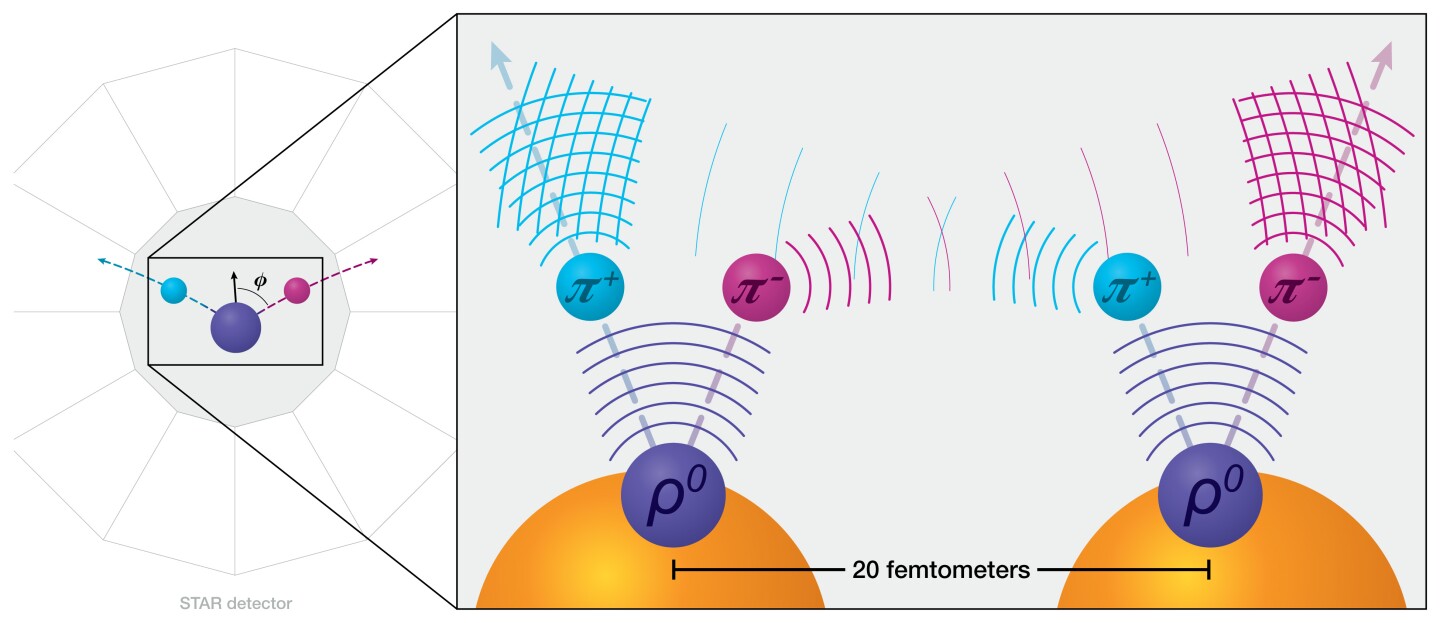
A diagram showing how the newly discovered type of quantum entanglement was detected. Yellow circles are gold ions, and blue and pink circles are positive and negative cations, respectively. Waves from each reinforce the waves of the same pion from the other ion, so that they hit the detector in two strong signals, which are seen as concentrations of blue and pink waves at the top of the image. This can only work if the positive and negative ion quantum entanglements from each ion occur, in a way that has not been observed before.
Brookhaven National Laboratory
“We measure two outgoing particles and clearly their charges are different they are separate particles but we see patterns of interference that indicate that these particles are entangled, or are interacting with each other.” are in sync with, even though they are different particles,” said Zhangbu Xu, a study author.
As well as expanding our understanding of quantum physics, the discovery could lead to new techniques, such as the method the team is using to peer inside the nuclei of gold ions.
The research was published in the journal science advance,
Source: Brookhaven National Laboratory