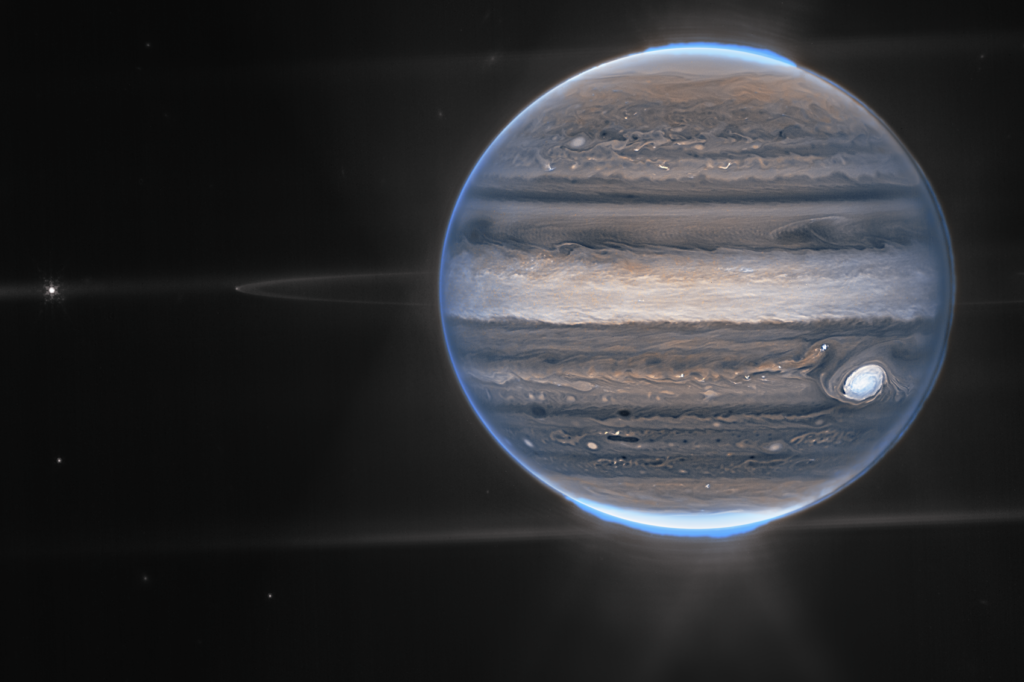
Cape Canaveral, Fla. (AP) – Astronomers have discovered 12 new moons around Jupiter, bringing the total to a record-breaking 92.
This is more than any other planet in our solar system. Saturn, the one-time leader, comes in second with 83 confirmed moons.
Scott Sheppard of the Carnegie Institution, who was part of the team, said the Jupiter moons were recently added to the list kept by the International Astronomical Union’s Minor Planet Center.
They were discovered in 2021 and 2022 using telescopes in Hawaii and Chile, and their orbits were confirmed with follow-up observations.
Read more: James Webb Space Telescope shows Jupiter’s aurorae, tiny moons
According to Shepard, these latest moons range in size from 0.6 miles to 2 miles (1 kilometer to 3 kilometers).
“I hope we can image one of these outer moons in the near future to better determine their origin,” he wrote in an email.
In April, the European Space Agency is sending a spacecraft to Jupiter to study the planet and some of its largest, icy moons. And next year, NASA will launch Europa Clipper to explore Jupiter’s moon of the same name, which may harbor an ocean beneath its frozen crust.
Shepard – who discovered several moons around Saturn a few years ago and has taken part in 70 moon discoveries around Jupiter so far – hopes to add to the lunar tally of the two gas giants.
Shepard said Jupiter and Saturn are littered with small moons, believed to have once been fragments of larger moons that collided with each other or from comets or asteroids. The same goes for Uranus and Neptune, but they are so far away that it makes spotting the Moon even more difficult.
For the record, Uranus has 27 confirmed moons, Neptune 14, Mars two, and Earth one. Venus and Mercury come up empty.
The newly discovered moons of Jupiter have not yet been named. Sheppard said only about half of them are large enough — at least 1 mile (1.5 kilometers) or so — to warrant a name.