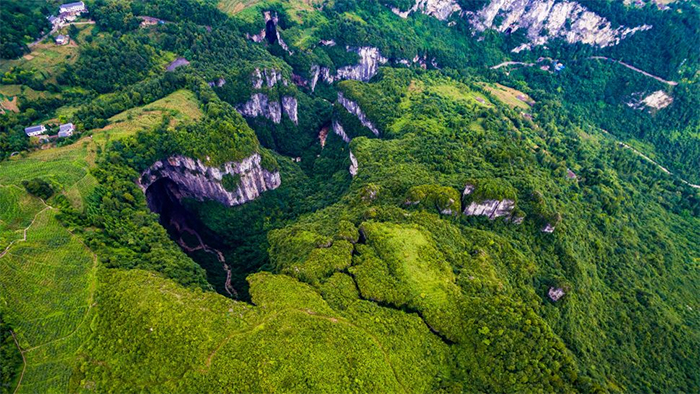
A team of Chinese scientists has discovered a huge new sinkhole with a forest at the bottom.
According to Xinhua news agency, the sinkhole is 630 feet (192 meters) deep, deep enough to swallow the St. Louis Gateway Arch.
A team of speleologists and spelunkers jumped into the sinkhole on Friday (May 6) after discovering that the abyss contained three cave entrances, as well as ancient trees 131 feet (40 meters) high, which shed their branches for sunlight. pull towards. Sinkhole entrance.
“This is good news,” said George Veni, executive director of the National Cave and Karst Research Institute (NCKRI) in the US and an international cave expert.
Wei was not involved in the discovery of the cave, but the organization, the Institute of Karst Geology of the China Geological Survey, is the sister institute of NCKRI.
a site for a sinkhole
The finding comes as no surprise, Wei told Live Science, as southern China is home to karst topography, a landscape riddled with dramatic sinkholes and otherworldly caves.
Veni said that karst landscapes are mainly formed by the dissolution of cornerstones. Rainwater, which is slightly acidic, picks up carbon dioxide as it moves through the soil, becoming more acidic. It then flows, runs and flows through cracks in the base rock, gradually widening them into tunnels and voids.
Distinctive karst sinkhole in Chongqing, China. (Eastimages/Getty Images)
Over time, if a cave chamber becomes large enough, the ceiling can gradually collapse, opening huge sinkholes.
RELATED: Skyscraper-sized sinkhole opens on Arctic sea floor
“Due to local differences in geology, climate and other factors, the way karst appears on the surface can vary dramatically,” he said.
“So in China you have this incredibly spectacular karst with huge sinkholes and huge cave entrances, etc. In other parts of the world you step out onto the karst and you don’t really see anything. The sinkholes can be quite small. can, only a meter or two in diameter. Cave entrances can be very small, so you have to squeeze your way into them.”
In fact, 25 percent of the United States is karst or pseudokarst, with caves carved by factors other than dissolution such as volcanoes or wind, Veni said. About 20 percent of the world’s landmass is made up of one of these two cave-rich landscapes.
According to Xinhua news agency, the new discovery took place in the Guangxi Zhuang Autonomous Region near the village of Ping’i in Leyi County. Guangxi is known for its spectacular karst formations, which range from sinkholes to rock pillars to natural bridges, and the region has UNESCO World Heritage Site status.
Why sinkholes matter
Zhang Yuanhai, a senior engineer at the Institute of Karst Geology, told Xinhua that the interior of the sinkhole is 1,004 feet (306 meters) long and 492 feet (150 meters) wide.
The Mandarin word for such a massive sinkhole is “tiancheng” or “heavenly crater”, and the bottom of the sinkhole actually seemed like another world.
Chen Lixin, who led the cave expedition, told Xinhua that the deep underground on the floor of the sinkhole was as high as a man’s shoulders. Veni said karst caves and sinkholes could provide an oasis for life.
“I wouldn’t be surprised to learn that these caves contain species that have never been reported or described by science until now,” Lixin said.
In a West Texas cave, Veni said, tropical ferns grow in abundance; The spores of the fern were apparently carried to the shelter by bats migrating to South and Central America.
Not only do sinkholes and caves provide shelter for life, they are also a conduit for aquifers, or deep stores of underground water. Veni said karst aquifers provide the sole or primary water source for 700 million people worldwide. But they are easily accessible and dry up or become polluted.
“Karst aquifers are the only type of aquifers you can pollute with solid waste,” Veni said. “I’ve pulled the car batteries and the car bodies and the bottles of god-knows-what and god-what out of the active cave stream.”
According to Xinhua news agency, the new discovery brings the number of sinkholes in Lei County to 30. The same researchers previously discovered dozens of sinkholes in northwest China’s Shaanxi province and a group of interconnected sinkholes in Guangxi, China Daily informed of.
Related Content:
Snakes and waterfalls discovered inside Yemen’s infamous ‘Well of Hell’
Photos of Stunning Natural Bridges
How are stalactites and stalagmites formed?
This article was originally published by Live Science. Read the original article here.