#throwback Thursday: The iPod is one of the most iconic devices of the 21st century and is the product that put Apple on the road to its current behemoth market position. We wrote this article in October 2011 because the original iPod was just turning 10 years old. This week, Apple announced that they were discontinuing iPod products altogether. We’ve bumped up this article as a piece of nostalgia and how we looked back at these devices to gain some perspective.
In 2001, Apple launched an MP3 player, which can be partly attributed to shaping the landscape of today’s mobile computing market. As well as being the best-selling portable media player and saving Apple from almost irrelevance, the iPod influenced many of Cupertino’s ambitious and revolutionary projects, bringing much of the industry into a permanent state of catch-up.
The iPhone gave birth to the smartphone as we know it and, despite Microsoft’s initial dabbling, continues to stand as the best-selling device of its kind alongside the iPad and tablet segment. Software-wise, the iTunes Store paved the way for digital music sales and represents the world’s largest music retailer, while App Store sales dwarf all the competition combined — Android included.
In fact, the iPod and related products inspired Apple to change its name from “Apple Computer” to “Apple”. Irrespective of Apple’s every effort, we’d like to pay tribute to the company’s game-changing gadget on its 10th birthday. Join us as we take a brief stroll down memory lane…
original ipod
October 23, 2001 — 5GB, 10GB
The first iPod was developed in less than a year and although it didn’t turn the music industry upside down overnight—in fact, it received a lot of criticism—it did set the conceptual framework for things to come.
Powered by a dual-core 90 MHz ARM-based PortalPlayer processor and a 5GB 4200 rpm Toshiba HDD (a 10GB version came later), the rudimentary device supports only Mac computers as well as AAC, MP3 and WAV audio files. . The first version of iTunes for Mac was released in January of the same year.
Must see: Watch the first iPod being introduced by Steve Jobs…
ipod 2nd generation
July 2002 — 10Gb, 20Gb

Apple’s second-generation music player arrived less than a year after the original device and brought a number of refinements, including a cover for the FireWire port, an improved hold switch, and double the storage capacity.
It also abandoned the first-gen mechanical scroll wheel in favor of the touch-sensitive wheel used on many future iPods. This model introduced support for Windows via MusicMatch. Earlier, tech-savvy users were forced to use workarounds for Windows compatibility.
iPod 3G
April 2003 – 10GB up to 40GB

By April 2003, Apple underwent a complete redesign of the iPod, adding an all-touch interface, a dock connector, a slimmer body, and doubling the maximum storage capacity to 40GB. The company also brought its own media platform (iTunes 4.1) for Windows, breaking ties with MusicMatch.
The growing popularity of the iPod prompted retailers Best Buy, Target and Dell to carry the device between 2002 and 2003. Microsoft and Creative framed their rivals, Media2Go and Nomad Zen.
first ipod mini
Jan 2004 — 4GB

After focusing on adding features to the original design, Apple went back to the drawing board and introduced a slightly minimalist iPod. The $249 iPod mini was the first to have Apple’s click wheel and only offered 4GB of storage.
Despite its slimmer, trendy design, many criticized the device’s value. Around the same time, Apple replaced its $299 10GB iPod with a 15GB model, forcing retailers to reduce the 10GB model to $249. This made consumers even more suspicious of the Mini.
iPod 4th Generation and iPod Photos
July 2004 — 20GB up to 60GB

The first fourth-gen version arrived in July with a redesigned hold switch and the iPod mini’s click wheel. In October, Apple introduced a premium version called iPod Photo ($499-$599), which had improved battery life (15 hours versus 12), a color screen, and support for common image formats, notably album art. was good for
In February 2005, Apple replaced the 40GB iPod Photo with the thinner, cheaper 30GB model. By June, it decided to merge the iPod Photo and iPod “Classic” lines. The photo above shows the first U2 Special Edition iPod.
iPod Shuffle: 1st and 2nd-Gen
January 2005 and September 2006 – 512MB up to 2GB

Further shrinking its media player, Apple introduced the first iPod Shuffle in early 2005. It only worked as an entry-level model with 512MB or 1GB of storage and no display. Pricing was originally set at $99-$149. The second-gen shuffle came well over a year later. It was about half the size of its predecessor, with a belt clip and a more attractive aluminum case. Apple called it “the most wearable iPod ever.” Despite its smaller size, it doubled the storage capacity to 1GB and 2GB.
first ipod nano
Sep 2005 — 1GB up to 4GB

The second-generation iPod Mini landed shortly after the first Shuffle and offered an incredible 18 hours of battery life (the first Mini lasted 8). It also offered a 6GB model with minor cosmetic tweaks.
The Mini line was later discontinued in 2005 when Apple shipped the first iPod Nano, which was essentially a smaller version of the Mini (half the thickness and about 11mm narrower). However, it had a lower maximum storage (4GB versus 6GB) and a shorter 14-hour battery life.
iPod 5th Generation (Video)
October 2005 — 30GB up to 80GB

2005 was a memorable period for the iPod. Along with refining the fourth-generation iPod and releasing the Mini 2, Nano 1, Shuffle 1, Apple unveiled a completely redesigned fifth-gen iPod with a thinner case, a larger 2.5-in. 320 x 240 screen, and support for common video formats such as MP4 and H.264.
That feature earned it the nickname “iPod Video”. Additionally, sales that year increased by 400% to 22.5 million units, which dwarfs all previous years. joint,
iPod nano 2nd-gen
Sep 2006 — 2GB up to 8GB

Compared to the previous year, 2006 was fairly mild for the iPod, although sales remained strong and represented nearly half of Apple’s total revenue. It brought a new version of the increasingly popular Nano, which offered a scratch-resistant anodized aluminum casing, more color options, a brighter display, double the storage size, and a massive increase in battery life from 14 to 24 hours. The second generation Shuffle was also released, as was the 80GB version of the fifth generation iPod.
first ipod touch
Sep 2007 – 8GB up to 32GB

In an ironic twist, Apple introduced the biggest overhaul of the music player, with the iPod arguably responsible for the creation of the iPhone. Using existing iPhone hardware and software, it was the first iPod to feature a multitouch display and Wi-Fi. This allowed web browsing through Safari on the iPod, as well as access to the iTunes Store and YouTube. It only lacked the cellular connectivity of the iPhone and services with its speakers and camera.
iPod classic and iPod nano 3rd-gen
September 2007 — Classic/Nano 4GB and 8GB up to 160GB

The “classic” branding for the traditional iPod did not arrive until the sixth generation. Apple’s latest addition sheds the familiar white polycarbonate front plate for silver anodized aluminum, and it skips the special edition model. It also had a thinner shell, a new user interface, and offered up to 36 hours of music and 6 hours of video playback.
Although the iPod touch made headlines during Apple’s launch in September 2007, the company also unveiled a promising Nano revision that ditched the rectangular shape in favor of a smaller, almost square design. It was 19mm shorter and 11mm wider than its predecessor, with similar storage capacity and battery life. It more than doubles the resolution from 176×132 to 320×240 and gets a Cover Flow interface. Some criticized the third-gen Nano’s lack of a touchscreen.
iPod nano 4th and 5th-gen
September 2008 and September 2009 — up to 16GB
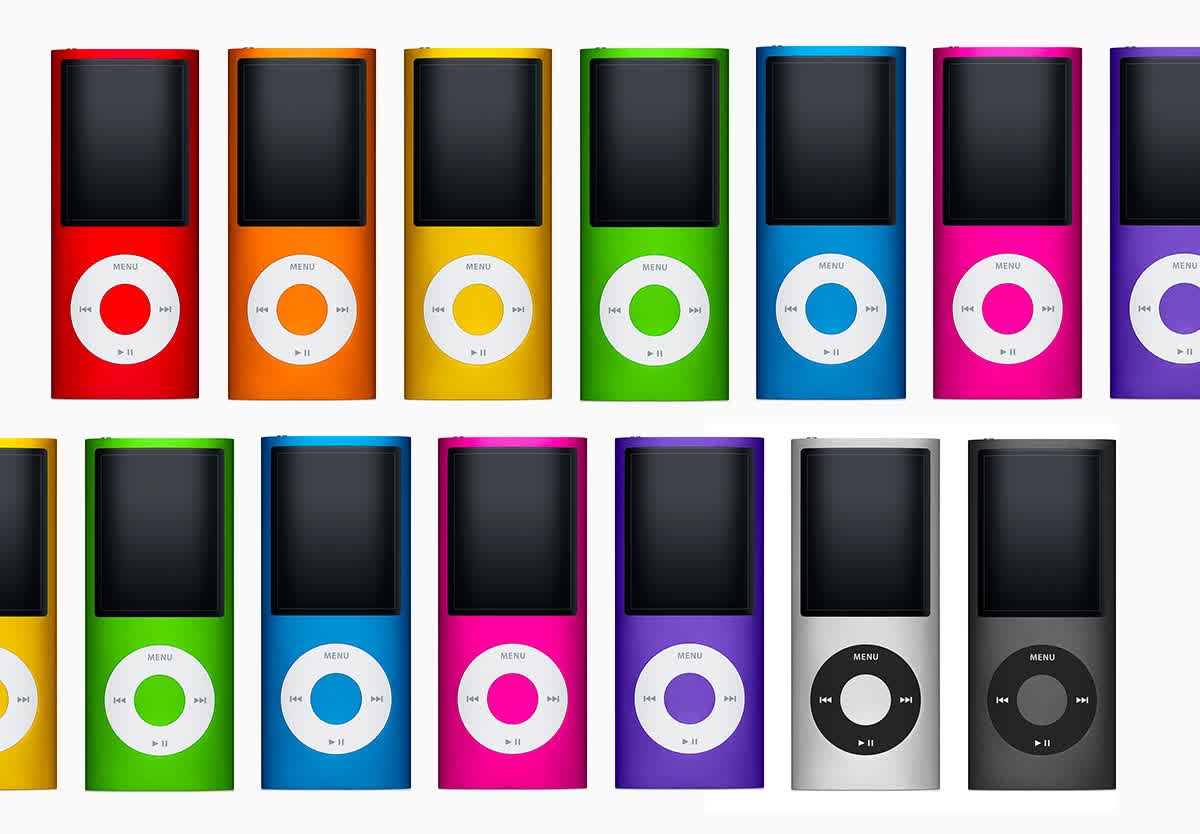
The fourth generation Nano reintroduced the elongated shell, although Apple was reducing 0.5 mm in thickness and 12.5 mm by weight, despite adding a larger display, more storage, as well as horizontal viewing (for video) and accelerometers for capacity. I succeeded. To shuffle songs by shaking the device.
The design was refined the following year as the fifth-generation iPod nano received a larger screen, a camera, an FM radio, a speaker, a pedometer, improved jack placement, and a polished paint job.
iPod Touch 2nd and 3rd-Gen
September 2008 and September 2009 – up to 32GB (2nd-Gen), up to 64GB (3rd-Gen)

Like the iPhone, the iPod Touch remained largely unchanged through its first few revisions. The second generation device got a slim chrome back, volume buttons and a built-in speaker. More importantly, it was the first iPod to ship with Apple’s newly created App Store.
The third-generation iPod touch mirrored changes from the iPhone 3GS, including a model with a faster processor and graphics core, more RAM, voice control support, and 64GB of flash storage.
iPod Shuffle 3rd-Gen
March 2009 — Up to 4GB

Although Apple refreshed the second generation shuffle several times with new colors, the series went about three years without any serious changes. Its successor shipped in March 2009 with double the storage (4GB), a smaller body reminiscent of Apple’s earlier Shuffle design, and an entirely new interface.
Instead of hardware buttons on the device, Apple moved volume and playback controls to the right earbud cable and introduced VoiceOver functionality for hands-free control.
iPod nano 6th-gen and iPod shuffle 4th-gen
Sep 2010 — Up to 16GB (Nano), 2GB Shuffle

The sixth-generation iPod nano borrowed elements from the 2007 iteration but delivered what the third generation couldn’t: a touchscreen. The device had a 240×240 multitouch display and given its 1.47 x 1.61-inch dimensions, Apple cut its predecessor’s camera and video playback, but retained functionality relevant to active users such as the pedometer.
Meanwhile, the fourth-generation iPod Shuffle essentially functioned as an entry-level Nano without a touchscreen or accelerometer.
iPod Touch 4th-Gen
Sep 9 2010 — Up to 64GB

After nearly three years and four generations since the first touchscreen model, iPod sales began to decline significantly—a fortune largely driven by the iPhone and competing Android handsets.
The line between portable music players and smartphones (especially the iPod touch and iPhone) had become incredibly blurred. However, the fourth-generation iPod Touch represented Apple’s best offering at the time, with a high-resolution “Retina” display, Apple’s A4 SoC, as well as front and rear cameras for FaceTime and video recording.
So, what iPod models have you owned over the years? Share your thoughts in the comments.