
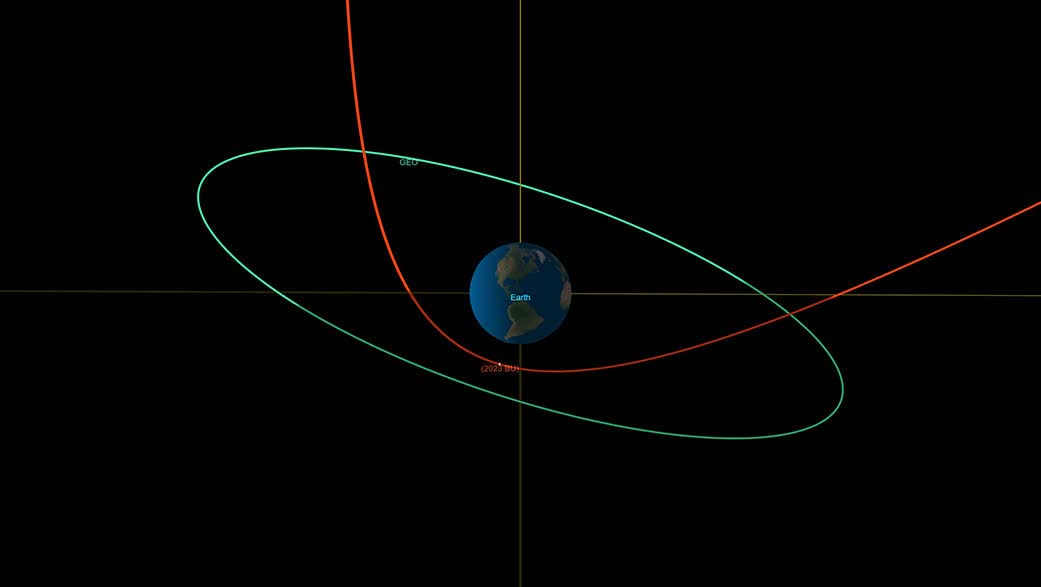
that was close! An asteroid roughly the size of a large SUV or larger zipped past Earth on Thursday evening, skipping us just 2,000 miles away. NASA said it was one of the closest flybys of a near-Earth object in recorded history.
On Thursday, an asteroid passed Earth in what NASA says is “one of the closest approaches by a near-Earth object ever recorded.” The space rock known as “asteroid 2023 BU” flew over the tip of South America on Jan. 26 at 7:27 a.m. EST. According to the US space organization, the object passed only 2,200 miles from the Earth’s surface. This distance is more than 10 times the altitude of geosynchronous satellites, which are about 22,000 miles away.
Astronomers estimate that asteroid 2023 BU will be about 3.5 to 8.5 meters wide. While the flyby was closer than any since we started observing these things, NASA says it was never a direct threat to Earth. If it had been on a collision course, its size would have turned it into a blazing fireball that would explode before it touched the grounda spectacular light show, but not a very dangerous one.
“It will be small asteroid [have turned] in a ball of fire and at large [disintegrated] “While harmless in the atmosphere, some large debris is potentially falling as small meteorites,” NASA said.
The asteroid is a relatively new object, having been discovered only last Saturday, hence the 2023 BU designation. It was observed by Gennady Borisov from a Crimean observatory, also observed by astronomers around the world.
The Scout Impact Risk Assessment System at NASA’s Jet Propulsion Laboratory (JPL) quickly calculated the asteroid’s orbit using limited data from the observatories. Scout determined that it would miss Earth, catapult around the planet, and return to deep space.
“Scout dismissed 2023 BU as an impactor, but despite very few observations, it was able to predict that the asteroid will make an exceptionally close approach to Earth,” said Scout developer and JPL engineer David Farnocchia. “In fact, this is one of the closest approaches by a known near-Earth object ever recorded.”

Earth’s gravity deflected 2023 BU’s orbit, lengthening its path and extending its solar year to 66 days.
The asteroid passed so close that NASA expects its regular orbit around the Sun to be permanently altered. Prior to the close encounter, the object’s course around Sol was nearly circular, with a 359-day year. Now its orbit will be elliptical, running about halfway between the solar paths of Earth and Mars. Due to this change, it will now take 425 days for the asteroid to orbit the Sun.
Although asteroid 2023 BU did not pose any real threat, its near miss reminds us that we are not alone in the solar system. Larger objects could potentially end life on Earth in a catastrophic collision.
NASA astrophysicists and scientists are alert and aware of this danger, which is why the space agency is developing a system for breaking up a spacecraft and moving large space rocks out of a collision course.
Last year, DART (Double Asteroid Redirect Test) successfully slowed down a 160-meter “moonlet” of a non-threatening asteroid by 32 minutes. The impact proved sufficient to eject large rocks from a collision course with Earth. The space agency said slowing the orbit down to more than 73 seconds would have been successful.
Masthead Credit: Kevin Gill


