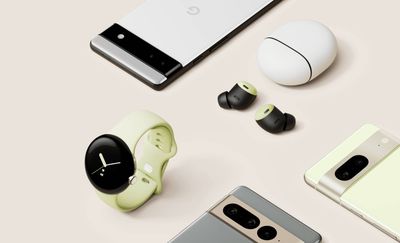
Google announced Android 13 in full glory alongside a beta 2 rollout using an I/O conference. However, the event did serve to introduce new hardware such as the Pixel 6a and tease the upcoming Pixel Watch and Pixel 7 series. We were expecting the Pixel Watch to arrive at this event, but apparently, the company still needs time and a bigger event. The device will only arrive in October, which is funny considering how many leaks are surfacing. Of course, Google isn’t known for doing a good job at keeping its hardware secret. The Pixel Watch was said to come with Exynos 9110, which is a bit concerning considering the age of this chipset and the manufacturing process (10nm from 2018). However, recent reports suggested that it may be coming with a co-processor for power efficiency.
Pixel Watch Hardware Details
Now, the co-processor is named Cortex-M33 by Max Winebach. The power draw of the Cortex M33 is measured in micro Watts. Hence, this rumored 300 mAh battery may last for a long time. Apart from the co-processor, the Exynos 9110 will be paired with 1.5GB of RAM and 32GB of internal storage. Since we are talking about a small smartwatch, these two parameters are quite high. Also, apps and features should not be so demanding. We’re not quite sure, as the Pixel Watch will feature the next WearOS version. The device reportedly comes with software pushing rather than hardware. However, the RAM and storage are great for a smartwatch, despite the old CPU.
LTE connectivity
The Pixel Watch will feature a linear motor for haptic feedback. This will provide better vibration than watches with a typical vibration motor. So far, three versions of the Pixel Watch have been seen in the FCC database. One only has Wi-Fi and Bluetooth connectivity (GQF4C). The other two have LTE (GBZ4S and GWT9R). The first supports only three bands – 5, 6, and 26, while the GWT9R will support much more bands: 2, 4, 5, 12, 13, 17, 25, 26, 66, and 71. Presumably, the former is a carrier-locked device with only the necessary bands.
Cellular connectivity will make this device more independent and smart. After all, you won’t need to rely on your smartphone all the time and you’ll be free to use apps that require an internet connection.
There will also be a USB Type-C plug in the charging puck for the wearable. Hence, those receiving Pixel smartphones will be able to use the same charger that comes with the USB C-to-C cable. According to the report, Compal has been listed as the ODM of the Pixel Watch. This company has a lot of experience in manufacturing wearables. Interestingly, it has been a major manufacturer of the Apple Watch over the years. So Google Pixel Watch owners can expect similar quality.
Google teased the Pixel Watch as a product coming “fall” this fall. We believe it will launch alongside the Pixel 7 series, which may arrive in the usual October.